Is POD a Piece of Cake? Know the Unknown Truth | BinMahmood
BinMahmood · POD Reality Series · Part 1 of 4
When business slows down, you have two choices — wait for it to pick back up, or use the time to learn something new. I chose the second. Scrolling through social media one day, a post about Digital Arabic Calligraphy stopped me mid-scroll. Something about it felt different. I started learning — and I am still learning — because with calligraphy, the learning never truly ends.
Audio discussion of this post — powered by NotebookLM
A two-host podcast discussion of this blog, generated using Google NotebookLM.
As a self-employed person, skills eventually become business ideas. Graphic design was already an overcrowded market long before I arrived, and jumping into it as a generalist was never on my list. What I did see was something more specific: a fusion of Arabic, Urdu, Persian, and English scripts, created entirely digitally, offered as wall art and personalised products through a print-on-demand model. That felt like a real opportunity.
So I went looking for guidance. And YouTube had plenty of it.
The YouTube Version of POD
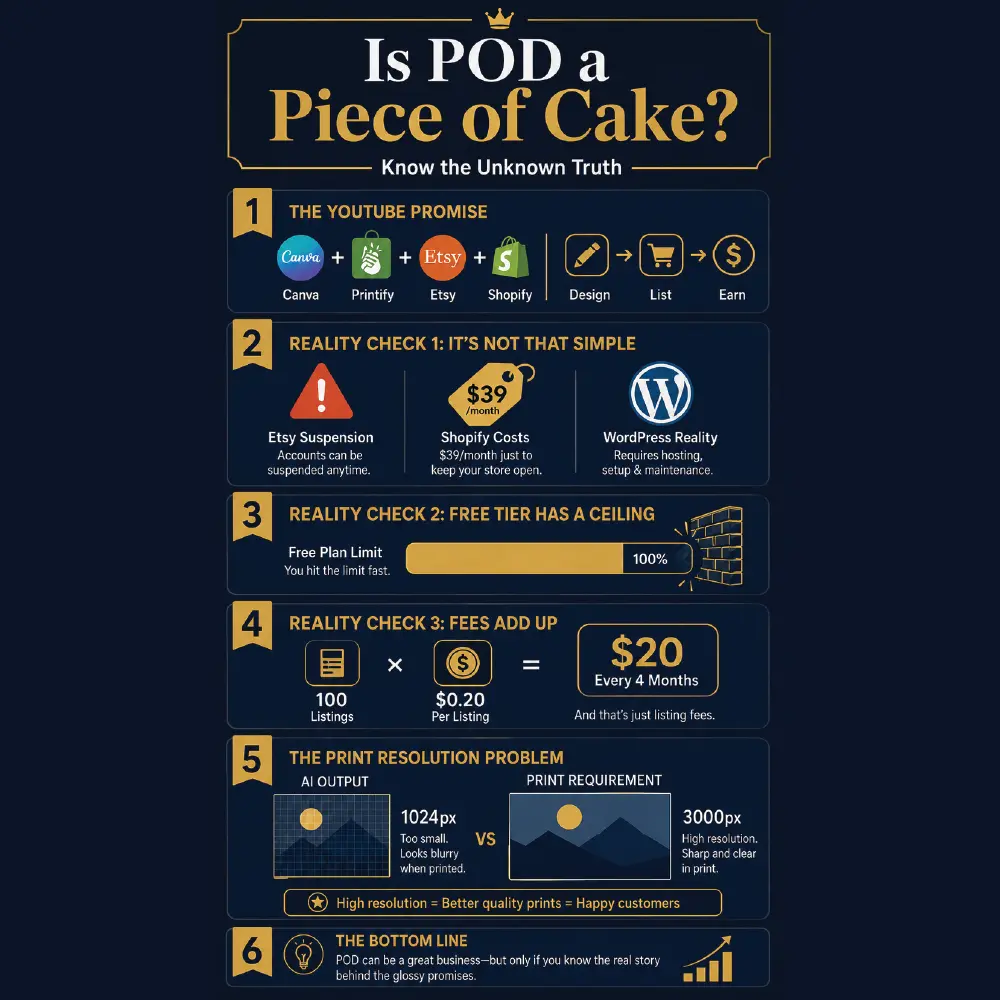
Before ChatGPT changed how people find information, YouTube was the first stop for learning almost anything. Search “how to start a POD business” and hundreds of videos would appear — most of them telling the same story, in almost the same order:
- 1Create an account on a fulfilment provider / 3PL (third-party logistics company) like Printify or Printful
- 2Pick everyday items — caps, t-shirts, mugs, tote bags
- 3Open Canva, find some free design elements, drag them onto your product — or visit an AI image generation platform like Midjourney, DALL-E, Playground AI, Ideogram, or Leonardo AI, generate something, and copy-paste it onto the product
- 4Connect your store to the fulfilment provider
- 5List on Etsy, set up a Shopify store, or build a WooCommerce store on WordPress
- 6Start earning
Simple. Easy. Passive income waiting for you. The question worth asking — and one this series will leave open for you to decide — is this: is it really that easy?
The First Reality Check: Creating the Account
The videos made account creation sound like the easiest part. And to be fair, signing up for Canva or Printify is straightforward enough. But each platform you add to your stack brings its own considerations — and fewer creators will mention them openly.
Etsy is a marketplace with a well-documented history of account suspensions — sometimes without warning, sometimes permanently. You can follow every rule in their seller handbook and still find your account flagged or shut down. For a seller who has spent weeks building a shop, uploading listings, and writing product descriptions, a lifetime ban is not a minor inconvenience. It is losing everything you built. Fewer YouTube creators will mention this hustle — the camera rolls on a clean onboarding screen, and then it moves on.
Shopify is a CMS (Content Management System) rather than a marketplace, which means you own the storefront but you are responsible for bringing your own traffic. Shopify is not free — their basic plan starts at around $39/month, and the features most sellers actually need sit on higher tiers. There is also an onboarding cost to consider as you set up your store, theme, and integrations.
WordPress with WooCommerce is another CMS route — and the one BinMahmood runs on. WordPress itself is free and open-source, but hosting, a premium theme, plugins, payment gateways, and domain registration all carry their own costs. The upside is full ownership and flexibility. What you save in monthly platform fees, you invest in control.
Setting up your store — whether on a marketplace like Etsy or a CMS like Shopify or WordPress — deserves its own dedicated blog. We will cover the full setup process, the real costs involved, and how to choose the right platform for your situation.
The Second Reality Check: “Free” Has a Ceiling
Canva‘s free tier gives you enough to experiment, but the fonts, templates, and features that make your designs look professional sit behind a subscription. The same applies to fulfilment providers — free access gets you started, but scaling up often requires a paid tier.
None of this is hidden information. But fewer will tell you upfront, especially when the goal of the content is to make the entry look as easy as possible.
The Third Reality Check: Listing Fees Add Up
Even if you get your product designed and your account approved, selling costs money before you make a single sale.
Etsy charges $0.20 per listing, valid for four months, after which it auto-renews. For ten items, that is manageable. For one hundred items — which is closer to what a shop needs for real visibility — the fees accumulate quickly. And those charges run whether or not anyone buys.
Shopify takes a different approach: a monthly subscription fee regardless of sales volume, plus transaction fees on each order unless you use Shopify Payments — which is not available in all countries. The basic plan starts at around $39/month.
WordPress with WooCommerce shifts the cost model: instead of monthly platform fees, you pay for hosting, domain renewal, premium plugins, and payment gateway charges. The monthly cost can be lower — but it requires more technical management.
So at this point your stack looks something like this: a design tool, a fulfilment provider, and a marketplace or storefront — all with their own fees. And yet, you still have no customers.
The Hardest Part Rarely Discussed
Getting traffic to your store is the most challenging part of running a POD business, and it tends to get the least attention in beginner content. Beautiful products and a well-designed store are necessary — but not sufficient. If no one finds you, nothing moves.
Traffic requires consistent, ongoing effort: SEO, social media presence, content creation, or paid advertising. We will cover this in a dedicated part of this series, because it is a conversation on its own.
A Word on AI-Generated Designs
After the explosion of AI image generation tools, many aspiring POD sellers shifted their design approach. Platforms like Midjourney, DALL-E, Playground AI, Ideogram, and Leonardo AI made it feel like anyone could generate print-ready artwork in seconds.
There is a practical problem that often goes unmentioned: print resolution. AI-generated images are typically output at 1024×1024 pixels. A standard t-shirt front print — even at a medium chest placement of around 10″×10″ — requires a minimum of 3000×3000 pixels at 300 DPI for proper print quality. That is nearly nine times the pixel count of what these tools output.
To bridge that gap, you need an AI image upscaling service — tools like Krea.ai or the now largely defunct dgb.lol. But upscaling carries its own trade-off: AI upscalers frequently introduce distortion, artifacts, and unnatural traces into the image — details that look acceptable on screen but show up clearly on a physical print.
Several platforms have since evolved into more complete design tooling for POD workflows: Kittl, Recraft.ai, Dzine.ai, and X-Design are worth exploring. These offer more control and better output for print work — but their serious features sit behind payment plans.
The Payment Reality: Getting Paid Out
One thing worth clarifying: paying fees to platforms like Etsy or Printify is generally straightforward — a Pakistani debit card works fine for platform charges. The complexity comes on the other side: getting paid out.
Etsy has partnered with Payoneer for seller payouts in many markets. PayPal remains common across other platforms. If you are based in the US, UK, Canada, Australia, or similar markets, setting up either service is relatively simple — your personal credentials and local banking details are usually sufficient.
If you are outside that geography, the process is considerably more involved. Both Payoneer and PayPal typically require guarantees — in many cases a Social Security Number or equivalent personal credentials — that sellers in other countries simply do not have access to. In practice, many sellers in this situation move toward registering an LLC in the United States. That process, and everything involved in it, will be covered in a dedicated part of this series.

پیوستہ رہ شجر سے، امید بہار رکھ
“Stay connected to the tree, and hold hope for spring.”
— Allama Iqbal
POD Reality Series — All Parts
| Part | Topic | Status |
|---|---|---|
| Part 1 | Is POD a Piece of Cake? Know the Unknown Truth | You are here |
| Part 2 | The Real Cost of Running a POD Store | Coming soon |
| Part 3 | AI Art Looks Great. Until You Try to Print It | Coming soon |
| Part 4 | You Have a Product. Now Get the Customer | Coming soon |