
Rules of Arabic Calligraphy: Mastering the Ancient Art
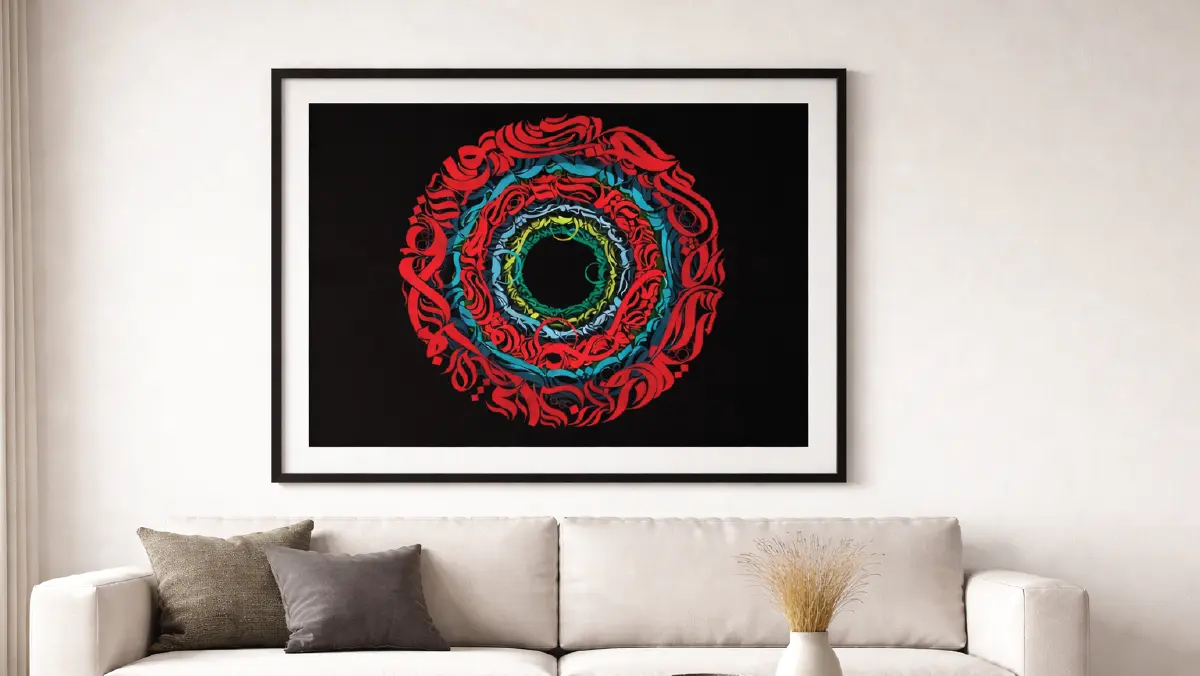
Arabic calligraphy is one of the most disciplined visual art forms in human history. Unlike decorative lettering in other traditions, Arabic calligraphy is governed by a precise system of rules — proportions, angles, spacing, and compositional principles developed by master calligraphers over more than a thousand years. These rules are not suggestions. They are the difference between calligraphy and handwriting.
This post breaks down the foundational rules of Arabic calligraphy — the principles every calligrapher, digital or traditional, works within. If you have ever wondered why Arabic calligraphy looks the way it does, or why some pieces feel balanced and others do not, these rules are the answer.
A Brief History of the Rules
The rules of Arabic calligraphy were not invented all at once. They evolved over centuries, formalized by a series of master calligraphers who recognised that the beauty of the script depended on consistency and proportion.
The most significant figure in this codification was Ibn Muqla (886–940 CE), an Abbasid vizier who developed the first geometric system for measuring Arabic letterforms. He introduced the concept of the rhombic dot — the diamond-shaped mark made by pressing a reed pen at a specific angle — as the foundational unit of measurement for all letters. Every letter’s height, width, and curve was defined as a multiple of this dot.
Ibn Muqla’s system gave Arabic calligraphy something rare among art forms: a mathematical foundation. The result was not rigidity but harmony — letters that related to each other proportionally, compositions that held together visually regardless of size or surface. His approach was later refined by Ibn al-Bawwab and Yaqut al-Musta’simi, whose work shaped the classical scripts that calligraphers study today.
For a deeper history of how these traditions developed, the Metropolitan Museum of Art’s essay on calligraphy in Islamic art is one of the most authoritative resources available. The UNESCO Intangible Cultural Heritage listing for Arabic calligraphy also documents the living tradition of these practices across cultures.
The Six Classical Scripts and Their Rules
Arabic calligraphy is not a single style — it is a family of scripts, each with its own rules, character, and historical purpose. Understanding which script you are looking at is the first step to understanding its rules.
1. Kufic
The oldest surviving Arabic script, Kufic is defined by its angular, geometric forms and strong horizontal baseline. Where most Arabic scripts flow and curve, Kufic holds its ground — vertical strokes are sharp, horizontal strokes are extended, and the overall impression is architectural rather than fluid. It was used primarily in early Quranic manuscripts and monumental inscriptions on mosques and buildings. The rules of Kufic are about precision of angle and the strict relationship between vertical and horizontal elements.
2. Naskh
Developed in the tenth century and refined by Ibn al-Bawwab, Naskh is the most widely used Arabic script today — it is the basis of most printed Arabic text, including the Quran in its modern published form. Its rules prioritise readability: letters are rounded, proportions are moderate, and the baseline is consistent. Naskh is the script most calligraphy students learn first because its rules are clearly defined and its proportions are regular.
3. Thuluth
Thuluth — meaning “one third” in Arabic, referring to the proportion of straight to curved lines — is the most ornamental of the classical scripts. Its letters are large, its curves are generous, and its vertical strokes are tall. It is the script most commonly seen in mosque inscriptions, architectural panels, and formal religious texts. The rules of Thuluth demand exceptional control: the proportions are strict, the curves must be exact, and the composition must balance verticals against diagonals with precision.
4. Diwani
Diwani was developed during the Ottoman Empire for official court documents and state correspondence. Its defining characteristic is the dense, interlocking quality of its letters — strokes overlap, letters merge, and the composition flows as a unified form rather than a sequence of separate letters. The rules of Diwani are among the most complex in Arabic calligraphy: letters must connect smoothly, the rhythm must be continuous, and the density must be controlled so the composition remains legible despite its visual intricacy.
5. Ruq’ah
Ruq’ah is the everyday script — designed for speed and efficiency rather than ornament. Its rules are simpler than those of Thuluth or Diwani, its letters are compact, and its proportions are practical. It is the script most Arabic speakers use for handwriting. In calligraphic terms, Ruq’ah’s rules are about consistency and rhythm rather than elaborate proportion.
6. Nastaliq
Nastaliq is the primary script of Urdu, Persian, and Pashto calligraphy — and it is the script that binmahmood uses most for Urdu name compositions. It moves diagonally across the page, with letters descending from right to left in a flowing cascade. Its rules are distinct from the Arabic scripts: the baseline shifts, the proportions are governed by the relationship between the hanging letters and the horizontal baseline, and the overall composition has a dynamic, directional quality that the Arabic scripts do not. The Google Arts and Culture feature on Nastaliq calligraphy and the Smithsonian’s exhibition on Nastaliq offer excellent visual context for this tradition.
The Foundational Rules That Apply Across All Scripts
While each script has its own specific rules, several principles govern all classical Arabic calligraphy regardless of style.
The Rhombic Dot as the Unit of Measurement
Every classical Arabic script is built on a system of proportional measurement rooted in the rhombic dot — the mark left by a reed pen pressed at a 45-degree angle. This dot is not decorative; it is the foundational unit from which all letterform proportions are calculated. The height of an alif, the width of a ba, the curve of a waw — all are defined as multiples of the dot. This system, introduced by Ibn Muqla in the tenth century, gave Arabic calligraphy its mathematical coherence and is still the basis of classical training today.
Pen Angle and Pressure
In traditional calligraphy, the angle at which the pen is held determines the weight distribution across letters — the thick and thin of each stroke. Most classical scripts use a pen angle of approximately 45 degrees. Deviating from the correct angle changes the character of the letterforms entirely. Pressure must also be consistent: too much pressure flattens the stroke, too little loses definition. In digital calligraphy — such as the work produced at binmahmood — pen angle is translated into the deliberate weight distribution of each Bézier curve, with stroke thickness varied by hand rather than by physical pressure.
Proportional Relationships Between Letters
No letter in classical Arabic calligraphy exists in isolation. Every letter’s size, weight, and position is calculated in relation to the letters around it. The height of a tall letter must relate proportionally to the width of a wide letter. The spacing between letters must be consistent with the internal spacing within letters. These relationships create the visual harmony that distinguishes calligraphy from handwriting — the sense that the composition holds together as a whole rather than a sequence of separate marks.
Flow and Rhythm
Arabic script moves from right to left, and classical calligraphy treats this directionality as a compositional quality rather than just a writing convention. The eye should move through a calligraphic composition smoothly, with letters connecting and flowing in a way that feels continuous rather than staccato. This rhythm is achieved through consistent stroke weight, careful management of connecting strokes between letters, and the overall pacing of the composition.
Balance and Compositional Harmony
A calligraphic composition must read well as a visual object — not just as text. This means the overall arrangement of letters and words must be balanced: no single area should feel heavy or empty relative to the rest. Tall letters must be offset by horizontal strokes. Dense passages must be relieved by open space. The composition should feel resolved — as if every element is exactly where it belongs.
Nuqta — The Diacritic Dots
Arabic letters are distinguished from one another largely by the placement of nuqta — diacritic dots placed above or below the baseline letter. In classical calligraphy, the size, position, and angle of every nuqta is precisely defined. A dot that is too large, too small, or misaligned changes the letter it marks — and in a Quranic context, can change the meaning of the text. Getting the nuqta right is one of the most demanding aspects of classical calligraphic training.
How These Rules Apply to Digital and Fusion Calligraphy
A question that comes up regularly: do these rules apply to digital calligraphy, or only to work produced with a reed pen?
The rules apply regardless of the tool. The proportions of Thuluth, the flow rules of Nastaliq, the nuqta standards of Naskh — these are properties of the letterforms themselves, not of the instrument used to produce them. A reed pen is one way to execute these rules. A mouse in Adobe Illustrator, with Bézier curves placed anchor point by anchor point, is another.
At binmahmood, every name composition is checked against the classical rules of the chosen script before it goes to production. The proportional relationships between letters, the weight distribution across strokes, the placement of nuqta — all of these are applied by hand, point by point, in the same way a traditional calligrapher applies them stroke by stroke. The tool is different. The knowledge is the same.
This is the argument at the heart of Arabic calligraphy versus digital fonts — a distinction that matters more than most people realise. A font is a fixed set of letterforms applied uniformly to any input. Calligraphy — digital or traditional — is a composition built specifically for the name, the script, and the product it will appear on.
What This Means for a Custom Name Piece
When you commission a custom name in calligraphy from binmahmood, the rules above are what govern the work. The name is not typed into a font. It is built — letterform by letterform, proportion by proportion, within the classical rules of the chosen script.
The script is selected based on the name’s linguistic heritage and the product’s purpose. The proportions are calculated relative to the specific dimensions of the product. The nuqta are placed precisely. The composition is reviewed for calligraphic correctness, visual balance, and product fit before a digital preview is sent for your approval.
This is what the rules of Arabic calligraphy look like in practice — not as an academic exercise, but as the process behind every piece that leaves the studio.
If you would like to see your name composed within these rules, start a custom order here.
Further Reading
For those who want to go deeper into the history and principles of Arabic calligraphy:
- Metropolitan Museum of Art — Islamic Calligraphy Bulletin
- Metropolitan Museum of Art — Calligraphy in Islamic Art
- UNESCO — Arabic Calligraphy: Knowledge, Skills and Practices
- Asian Art Museum — The History of Islamic Calligraphy
- Google Arts and Culture — Nastaliq Calligraphy
- Smithsonian — Nastaliq: The Genius of Persian Calligraphy
- Britannica — Nastaliq Script
- Victoria and Albert Museum — Islamic Middle East Collection
- British Museum — Islamic World
Also on binmahmood
- Arabic Calligraphy vs. Digital Fonts — Why the Difference Matters
- The Golden Age of Islamic Calligraphy
- How to Write Your Name in Arabic — A Guide to Authentic Calligraphy
- Best Personalized Arabic Calligraphy Gifts for Eid 2026
- Meaningful Eid Gifts That Go Beyond the Ordinary
Also on binmahmood.pk
- Classical Calligraphy vs. Fusion Calligraphy
- Mouse-Crafted vs. AI-Generated
- Personalized vs. Mass-Produced
- Print-on-Demand vs. Mass Manufacturing